












The Digital Workplace: How and when do businesses start?
Andrew Tan, Managing Director, JOS Singapore

Andrew Tan, Managing Director, JOS Singapore
Automation and artificial intelligence (AI) are two recent technological advancements which have greatly propelled the digital transformation of the workplace. Automation has replaced many administrative and operational tasks within offices, and AI is being used by cybersecurity companies to analyze network traffic patterns and detect attacks. Despite these benefits for organizations, both automation and AI have been viewed with some trepidation by employees. This is no surprise with studies reporting that up to 800 million jobs worldwide will be replaced by automation and how up to 50 million jobs in Asia are at risk from AI.
Yet, not everything is doom and gloom. A recent survey revealed that 66 percent of employers in APAC believed automation can enhance human performance and productivity. But changes should start from the top and with support and buy-in from leadership, the path to transforming the workplace should be relatively straightforward.
How should businesses begin?
With more business transformation initiatives supported by AI, cloud computing and automation, employers have a plethora of options in their journey to build a digital workplace.
From our experience working with a variety of local and regional businesses, we’ve learned that the best way to begin is to start small, but think big. Technology alone is not enough. A critical piece of digitization starts from within. People are at the core of such transformation and they are the crucial energy needed to drive successful digitization.
To encourage their workforce to share the same digitization journey and vision, business leaders need to be specifically cognizant of individual employees and how they operate to provide a more engaging workplace. Thus, it is important to start the journey through transforming workspace before achieving greater success across organizations.
Where to start: The foundation of a digital workplace
A true digital workplace goes beyond fancy pantries or biometric security systems.
It is important to start the journey through transforming workspace before achieving greater success across organizations
To help businesses to embark on this journey, we suggest five simple steps (see graphic) that marry people, technology and processes.
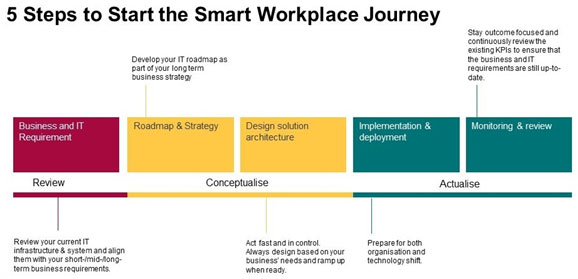
The first step would be for businesses to understand their business needs and review their IT infrastructure and system to ensure its agility and flexibility in this fast-changing digital workplace. One way to achieve that is to develop an IT roadmap as part of their long-term business strategy. Apart from its IT infrastructure, conceptualizing data and application architecture is another major piece in the formula to enable data availability to support the transforming business environment. The next step is to actualize these plans by implementing selected solutions, while bracing for the organizational and technological shift that follows. Lastly, businesses should also continuously monitor the performance of the solutions against premeditated KPIs, and review the workplace to ensure they are consistent with the requirements of the business.
The Digital Workplace: The time is now
Working with a wide range of industries, we have seen sectors across the region such as education and logistics benefitting the most from digital workplace transformation. Digitization in schools brings significant increases in student engagement. A recent collaboration with a local institute of higher learning saw us implementing a virtual desktop infrastructure (VDI). It was managed and hosted over a cloud environment to optimize management, control and support. The solution provides a cost-effective and flexible model for the education institute via a pay-as-you-use model.
We are also seeing cloud-based platforms revolutionizing the logistics and supply-chain industries by streamlining inventory management and communications.
With technologies like automation, AI, VDI and cloud computing maturing in recent years, this spells opportunities for the workplace to undergo digitization for achieving tangible benefits such as boosted productivity and efficiency. In order to unlock these benefits, businesses need to prioritize their pain points and identify the right solutions that best help them. To compete in the age of automation, the time to start your digital workplace journey is indeed now.

