

A featured contribution from Leadership Perspectives: a curated forum reserved for leaders nominated by our subscribers and vetted by the Construction Tech Review Advisory Board.

Fiserv
Creating an effective big data strategy that delivers business value

Dnyanesh Prabhu
“Tell me where I'm going to die, that is, so I don't go there”. –Charlie Munger
Improving your chances of success with a big data strategy need not be daunting. The focus of this article is on aspects which improve your chances of success with big data initiatives.
1. Create a data strategy that’s firmly aligned to the business strategy
It is important not to race ahead and create your big data strategy in isolation before considering the wider business.
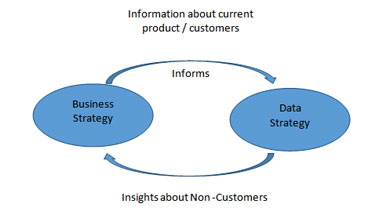
Ideally, a data strategy follows a business strategy, with a sound business strategy relying on the accessibility of reliable and accurate internal data and current external data.
An example to illustrate this point is the Nintendo Wii launch.
In 2007, the video game industry was dominated by top two players Microsoft X-Box and Sony-PlayStation. Nintendo was a distant third. Instead of going head-to-head with the market leaders, Nintendo used external data about non-customers e.g. older non-gamers, parents who wanted their children to play active games. Nintendo used actionable insights from the data gathered about these non-customer groups and launched Nintendo Wii, with a focus on simplicity and interactivity, to convert these non-customers into customers.
2. Seek executive sponsorship
For a successful big data initiative, executive sponsorship is a must. In the best-case scenario, the data program will be backed by an executive and supported by the CEO. The key is to prioritize the use cases which are aligned to the business strategy and to find sponsors who are willing to be early adopters. It is important to get early success to earn confidence that the data team and business can work together and deliver successful outcomes. Your initial success will turn the early adopters into advocates for your data program.
3. Aim to be a data-driven organization
A successful big data strategy should enable the organization to transform into a data driven organization(DDO).A modern organization finds its data residing in multiple sources, in multiple formats and multiple structures (structured, unstructured and semi-structured data). To become a DDO, business communities with varying data literacy should have seamless access to data.
Legacy data platforms based on relational databases are not optimized to ingest and process a variety of data.
A modern data platform should have the following characteristics;
• It can ingest internal and external data of various formats
• It can process large volumes of data in a cost-effective method
•It can support batch and real-time processing of data
•It can support BI/analytics and advanced analytics solutions
4. Deliver key functionalities as soon as possible
“I don’t look to jump over 7-foot bars; I look around for 1-foot bars that I can step over.”- Warren Buffet
Gone are the days when big programs were executed over multiple years to deliver EDW and BI solutions. With modern big data capabilities like Hadoop, it is easy to fall in a trap and focus on ingesting all the available internal and external data in a data lake. Instead, aim to deliver business value as early as possible by ingesting data only from data sources which will be required to the current project/program. Data end products should be released as early as possible using an MVP (Minimum Viable Product) approach where the focus will be on delivering key functionalities to customers as early as possible.
The first use case in the program should be a trivial and simple use-case and should not be the most important and the most complex project. More often than not, the most important and complex projects run into time/effort over-run and if you do not have any success to show prior to that, there is a good chance that business may lose confidence, and shut down the entire program.
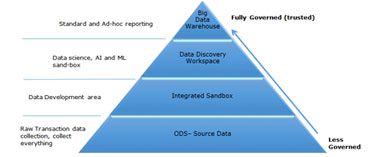
By starting with a small and trivial task, you will get an opportunity to implement necessary tweaks/changes in people/process without a big impact on the overall program. The focus should be on incrementally delivering multiple small improvements. When individually considered, these small improvements may feel insignificant, but when combined together, they can deliver big value.
5. Implement a change management program
“Would you persuade, speak of interest and not of reason.” – Benjamin Franklin
Creating actionable insights is only half the battle won. You need to have a necessary set up from the business side to take actions on those insights. That means changing the way the business operates and embedding analytics and insights based decision making in organization processes and structure. While it is important to centralize core capabilities like data engineering and analytics, use and consumption of data should be democratized. Having business buy -in and involving business from the inception of the project, provides necessary impetus for business to take action on the insights provided by your data program.
You can help your business create and establish a successful big data practice by following the above five actions. Such steps can prove to be a cornerstone to transforming the business into a truly data driven organization and provide the “Right Data to the Right People in the Right Way”.
